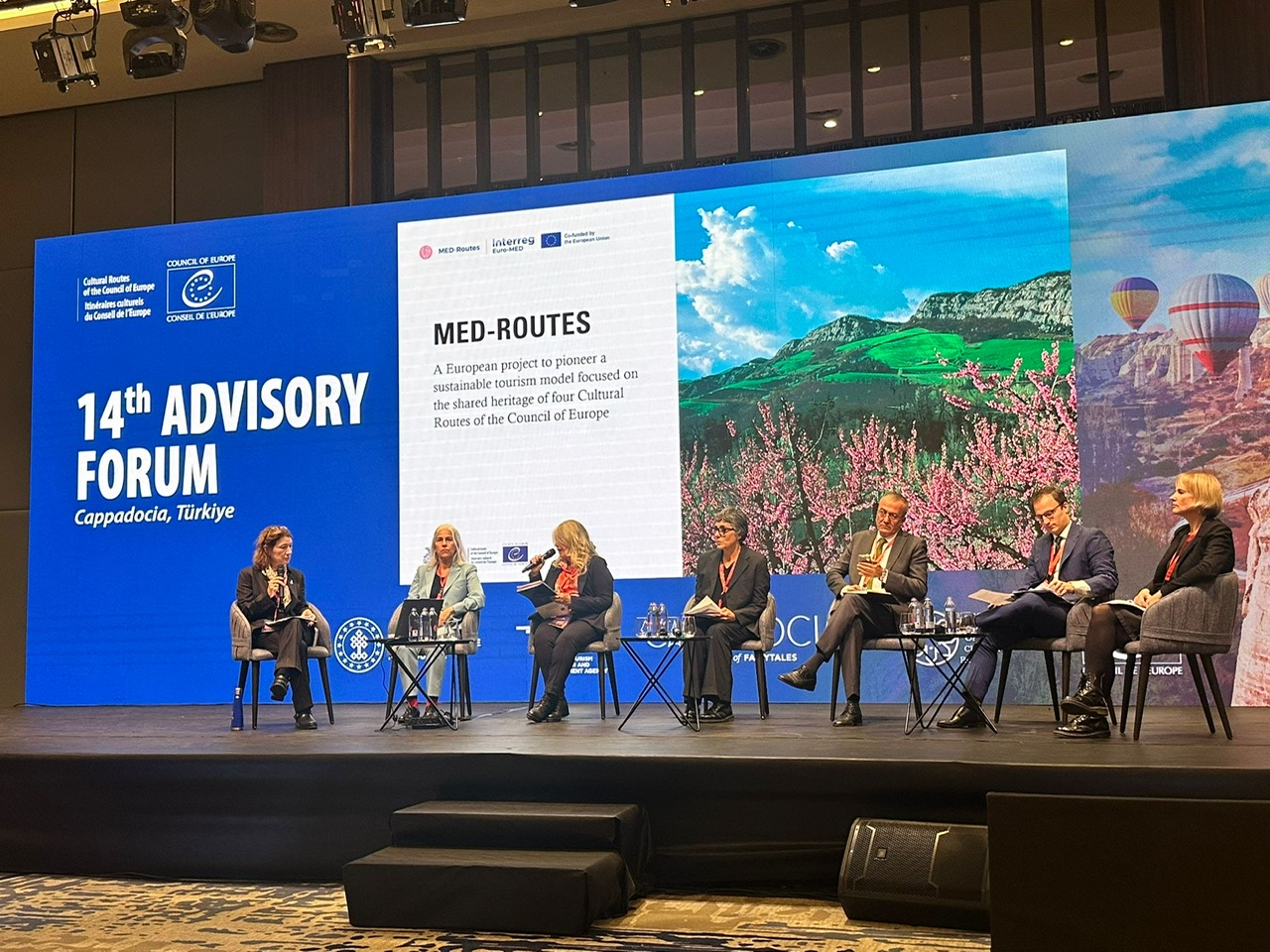

On 23 October 2025, during the 14th Annual Advisory Forum on Cultural Routes of the Council of Europe in Cappadocia (Türkiye), MED-Routes was presented to a global audience of over 380 participants, including representatives from ministries, regional authorities, cultural networks, universities, tourism bodies, UNESCO sites, and accredited Cultural Routes.
The presentation was delivered by Benedetta Diamanti, Director of the European Route of Ceramics and URF Coordinator of the MED-Routes project. Her intervention positioned MED-Routes as a strategic and scalable initiative supporting responsible cultural tourism development across Mediterranean territories.
🌍 MED-Routes: A Shared Vision for Cross-Route Sustainability
As highlighted by Benedetta Diamanti, MED-Routes is “a European project pioneering a sustainable tourism model focused on the shared heritage of four Cultural Routes of the Council of Europe”, involving:
working together with partners from Italy, Portugal, Spain, Croatia, Greece, Cyprus, and Bulgaria.
This cross-route cooperation is one of the distinguishing features of the project. As presented in Cappadocia, MED-Routes “fosters inter-CR collaboration to boost visibility and impact” and promotes territories beyond the most visited destinations.
🌱 A Model Aligned with Global Tourism Transformation
Global tourism trends show an accelerating shift toward sustainability, regeneration, and responsible travel — with the sector projected to reach $2.7 trillion in global value and 14% annual growth by 2034.
In her intervention, Diamanti emphasized that MED-Routes responds to this evolution, building on three foundational pillars:
-
Sustainable & responsible tourism
-
Circular economy principles
-
Regenerative approaches
— moving from mitigating damage to creating positive impact for communities and environments.
This framework places MED-Routes in direct alignment with European policy directions and with the Council of Europe Standards for Sustainable Cultural Route Management.
🧭 From Concept to Practice: Eco-Itineraries and Transferability
One of the key achievements presented was the design of eight pilot eco-itineraries, developed through community co-creation and integrating tangible and intangible heritage across routes and regions.
As stated during the session, MED-Routes is not only a project,
“It is a pilot designed to be replicated by other Cultural Routes.”
This approach supports the broader Council of Europe vision: Cultural Routes as living laboratories, capable of innovation, cooperation, and responsible territorial development.
🏷 A Sustainable Tourism Label for Continuity
One of the most anticipated outcomes presented at the Forum was the introduction of the MED-Routes Green Label — a certification intended to support:
-
responsible tourism practices,
-
adherence to sustainability standards,
-
and long-term project continuity beyond the funding period.
This labelling strategy positions MED-Routes within policy frameworks and market mechanisms, enabling future growth.
🤝 Expanding Collaboration with the Council of Europe
Presenting MED-Routes at the Advisory Forum marked a significant milestone in strengthening collaboration with the Council of Europe — the reference supranational institution for Cultural Routes.
This engagement ensures that the results of MED-Routes — including eco-itineraries, the methodological package, and governance recommendations — are visible, recognised, and available for transfer to the wider Cultural Routes network.
In line with the project ambition, the Cappadocia Forum helped position MED-Routes as:
a model that demonstrates how Cultural Routes can become drivers of sustainable, community-centred tourism across Europe.
🚀 Looking Forward
As the MED-Routes project approaches completion, the next phase focuses on:
-
enlarging cooperation with policy actors,
-
engaging Cultural Routes interested in replication,
-
promoting the eco-itineraries,
-
and operationalising the Green Label framework.
The participation at the Advisory Forum represents not just dissemination, but a strategic step toward embedding MED-Routes outcomes into Europe’s long-term cultural tourism policies.