What we achieve
Get a glimpse of our eco-itineraries
🏺EUROPEAN ROUTES OF CERAMICS
"Eco-itinerary in cultural landscape: clay and history, art and nature" - italy : Romagna Faentina
This eco-itinerary created in the Unione della Romagna Faentina, is one of the two eco-itineraries developed for the European Route of Ceramics.
The Unione della Romagna Faentina brings together six municipalities — each with its own unique character, yet all sharing a common identity. This area tells its story through culture, nature, widespread beauty, craftsmanship, thermal spas, food and wine traditions, and much more.
An experience that blends sustainability, heritage, and authenticity — inviting you to explore the soul of Romagna in a greener, slower way.
Check the map of the itinerary:
"From clay to art: a ceramic eco-Itinerary in Castelló" - Spain : CASTELLON DE LA PLANA
The “From clay to art: a ceramic eco-Itinerary in Castelló” of the , was developed for the European Route of Ceramics by The City Council of Castellón de la Plana and shows how the city is moving towards a model of sustainable tourism that brings together culture, industry, and innovation.The Castellón de la Plana Eco-Itinerary is the result of a collaborative process involving the entire community: ceramic artisans, researchers, industry representatives, cultural organisations, restaurants, residents, and the local administration. This joint effort has created a route that reflects the diversity and richness of the territory, integrating sustainability, creativity, and social commitment.
Castellón, one of Europe’s leading ceramic hubs, combines a strong technological industry with a deep artisanal tradition. The Eco-Itinerary celebrates both worlds — the innovation driving sustainability and the preservation of traditional know-how — showing how research and industry can become engines of cultural and environmental development.
In a flat, sunny, and accessible city with more than 300 days of sunshine a year, exploring the itinerary on foot or by bicycle offers a unique experience to discover ceramics in all its dimensions: art, science, and everyday life.
More than just a route, the Eco-Itinerary of Castellón de la Plana is a territorial innovation project, an example of how collaboration between community, knowledge, and industry can transform heritage into a true driver of sustainable growth.
Check the map of the itinerary:
🔗 Click here for the interactive map
🌿 ROUTES OF THE OLIVE TREE
"The Messinia Olive Odyssey" - Greece : messinia
The “Messinia Olive Odyssey Eco-Itinerary” invites travelers to explore one of Greece’s most emblematic regions through its enduring relationship with the olive tree. This micro-itinerary focuses on small-scale, sustainable tourism that connects visitors with local producers, traditional olive mills, organic farms, and century-old olive groves. It highlights practices that respect the environment—from organic cultivation and ecological recycling in olive oil production to responsible waste management and renewable energy use. Along the route, visitors can participate in olive harvesting, learn about traditional extraction methods, taste locally produced olive oil, and engage in cultural exchanges that deepen understanding of the link between heritage, land, and sustainability.
Set in the heart of the Peloponnese, Messinia is a region where history, nature, and culture converge. Once home to the Mycenaean civilization and later a center of Venetian maritime trade, it boasts landmarks such as the Palace of Nestor and the castles of Koroni and Methoni. For millennia, the olive tree has shaped its identity—economically, culturally, and spiritually. Messinia is the birthplace of the world-renowned Kalamata olive, a product of global acclaim and Protected Designation of Origin status. Today, the region continues to blend ancient traditions with modern ecological values, hosting organic farms, sustainable mills, and eco-friendly accommodations.
By integrating environmental education, local gastronomy, and outdoor experiences such as hiking, cycling, and agro-tourism, the itinerary extends tourism beyond the summer months while preserving natural and cultural resources. Through this approach, Messinia stands as a model for responsible Mediterranean tourism—where every olive tree tells a story of continuity, community, and coexistence with nature.
Check the map of the itinerary:
“From Warriors to Guardians: The Adriatic’s Legacy of Resilience” – Croatia: Korčula, Lastovo and Pelješac
The proposed eco-itinerary across Lastovo, Korčula, and the Pelješac Peninsula invites travelers to experience the Adriatic through the lens of sustainability, heritage, and tradition. Designed around principles of environmental stewardship and circular economy, it includes visits to family farms, workshops on dry-stone construction, permaculture, renewable energy, and water conservation, as well as heritage museums and eco-friendly accommodations. Along the route, visitors discover how ancient practices — from olive cultivation and salt harvesting to local gastronomy and crafts — are being revitalized to sustain both the land and the communities that depend on it.
For centuries, these same lands were shaped by warriors and sailors of the Republic of Dubrovnik, standing as fortresses against pirates and invaders. Today, the tools of battle have been replaced by olive branches, vineyards, and salt pans — symbols of peace and resilience. The olive tree, rooted in Adriatic soil for over 7,000 years, embodies this transformation: once a wartime resource, it now fuels local economies, cuisine, and well-being. Traditions like Korčula’s Moreška and Kumpanija sword dances or Lastovo’s Poklad carnival preserve the memory of these struggles while celebrating endurance and unity. Through this journey, visitors witness how the Adriatic has evolved from battleground to living heritage — a place where history, sustainability, and nature converge in harmony.
Check the maps of the proposed itineraries:
🔗Korčula – Where the olive tree meets a sword dance
🔗Lastovo – explore, experience, and preserve untouched nature
⚔️ DESTINATION NAPOLEON
The Fit and Green – “Go fit” where history goes greener” - Portugal : Vila Franca de Xira
The Fit and Green – “Go fit” where history goes greener”, focuses on locations such as forts, interpretation centers, squares, and other places of historical significance, as well as the stakeholders connected to these sites. This micro-itinerary promotes soft mobility practices, such as cycling or walking, encouraging sustainable interaction with the territory.
Check the map of the itinerary:
The Bistrot Spree – “The ultimate palais experience” – Portugal: Vila Franca de Xira
The Bistrot Spree – “The ultimate palais experience” , covers spaces such as restaurants and periodic events like fairs, with the goal of promoting elements of local culture. This itinerary stands out especially for its emphasis on gastronomy, fostering short supply and production chains. In doing so, it enhances the sustainability of the activities involved, aligning the gastronomic experience with the preservation of local resources and cultural practices.
Check the map of the proposed itinerary:
𐤀 PHOENICIAN'S ROUTE
”Wine, Food & Saints” - Cyprus : Pafos
Across the Mediterranean, the legacy of the Phoenicians lives on in Cyprus through a journey of wine, faith, and nature shaped by Aphrodite. The Pafos region blends UNESCO heritage with forests, valleys, and timeless villages where history and living culture meet.
The Pafos Forest and the Diarizos Valley reveal vineyards, monasteries, quiet hiking and cycling routes, and authentic hospitality in wine villages such as Panagia and Statos–Ayios Photios. Local gastronomy—halloumi, olive oil, carob syrup, and award-winning wines—captures the true flavour of rural Cyprus.
From Petra tou Romiou to the footsteps of St Paul, myth and faith shape a serene, all-season journey through the sacred landscapes of rural Pafos.
Check the map of the itinerary:
🔗The Wine, Food and Saints map
Watch the video of the itinerary in French, German and Greek:
🔗Video – French version
🔗Video – German version
🔗Video – Greek version
“Laona & Akamas ” – Cyprus : Pafos
The Akamas–Laona micro-itinerary follows the legacy of the Phoenicians along the Cultural Route, connecting Cyprus’ ancient maritime heritage with the rich cultural and natural landscapes of the Pafos region. Where myth, UNESCO treasures, and contemporary life meet, the journey unfolds through festivals, open-air arts, rugged coastlines, vineyards, and forested hills. The wild sanctuaries of Akamas contrast with the fertile valleys, olive groves, and stone villages of Laona, where living traditions endure. Museums dedicated to geology, flora, avifauna, turtles, and rural life enrich the experience, while year-round outdoor activities, mythology, and authentic gastronomy complete a journey shaped by history and inspired by nature.
Check the map of the proposed itinerary:
Watch the video of the itinerary in French, German and Greek:
🔗Video – French version
🔗Video – German version
🔗Video – Greek version
PROJECT RESULTS – YEAR 1
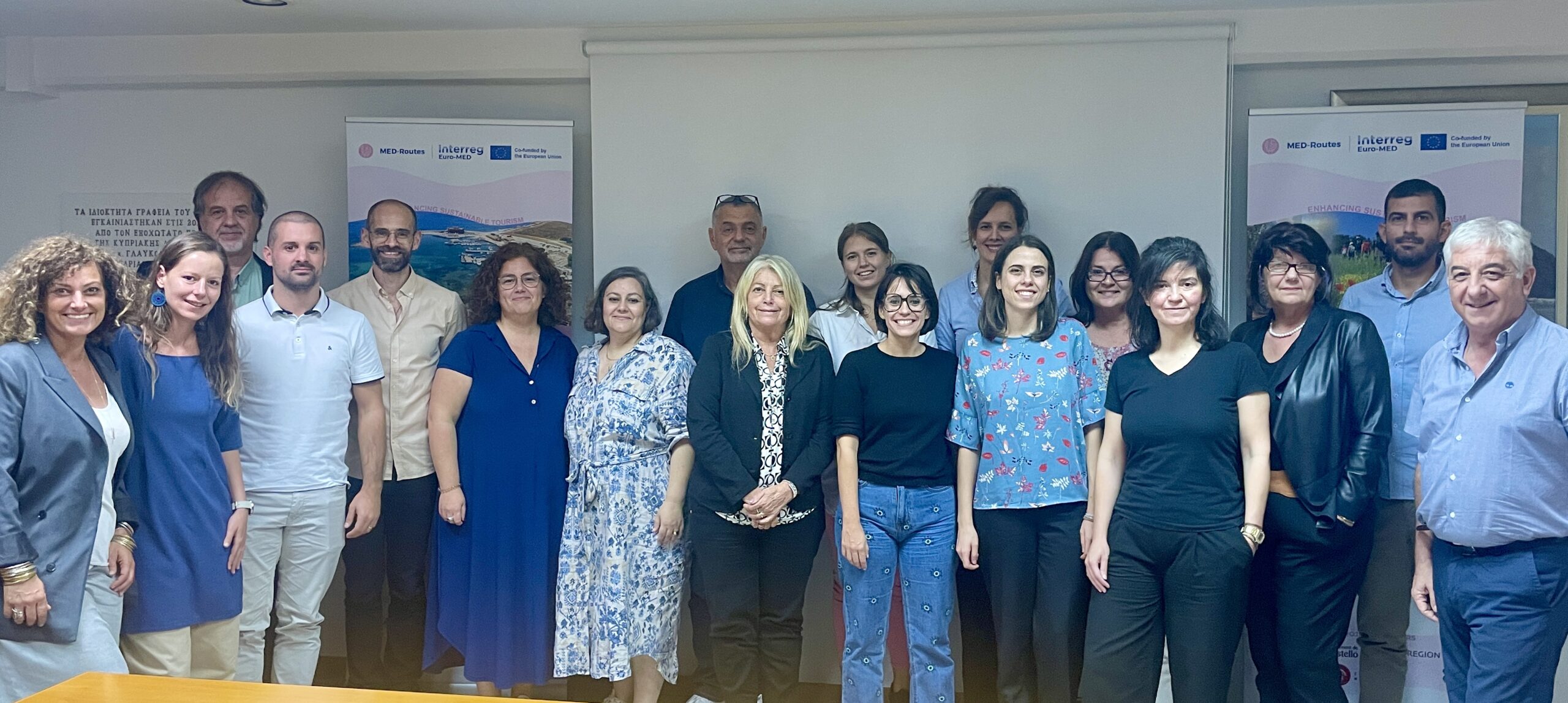

One Year of MED-Routes
In just one year, the MED-Routes project has made remarkable strides in advancing sustainable tourism across the Mediterranean. By integrating circular economy principles into the tourism and cultural sectors, we are shaping a more sustainable and resilient future for Mediterranean destinations.
🔹 Research and Analysis: Our first year was dedicated to extensive research and mapping of sustainable tourism initiatives. The development of Integrated Maps has been instrumental in identifying opportunities for implementing circular economy practices along cultural routes.
🔹 Participatory Labs: We launched our first collaborative workshops, engaging key tourism stakeholders in dynamic discussions. These participatory labs have fostered the co-creation of eco-itineraries that reflect the unique needs of our communities, ensuring a bottom-up approach to sustainable tourism development.
🔹 Transfer of Best Practices: Building on the success of EU projects such as INCIRCLE and EMBLEMATIC, we have begun adapting and integrating best practices to enhance the sustainability of our tourism itineraries. These proven strategies serve as valuable models for MED-Routes’ long-term impact.
🔹 International Teamwork: Recognizing the power of cross-border collaboration, we established a Transnational Working Group dedicated to key sustainability pillars: sustainable mobility, waste management, and renewable energy. This initiative reinforces our commitment to practical and scalable solutions.
🔹 Environmental Monitoring: To track and minimize our environmental footprint, we introduced a carbon footprint calculation system. This tool allows us to measure the impact of our activities, ensuring accountability and continuous improvement in our sustainability efforts.
🔹 European Synergies: Collaboration is at the heart of MED-Routes. Over the past year, we have engaged with other EURO-MED projects to facilitate knowledge exchange, foster innovation, and build a strong network for sustainable tourism.
🔹 Management and Communication: Our key meetings in Faenza (Italy), Varna (Bulgaria), and Pafos (Cyprus) have been pivotal in refining our strategies and strengthening our partnerships. Simultaneously, the launch of our website, facebook page and communication initiatives have significantly enhanced our project’s visibility and outreach.
Looking Ahead: This is just the beginning!
As we enter the second year of the MED-Routes Project, exciting developments are taking shape! From the development of a Green-label to the creation of 8 sustainable eco-itineraries, we’re making strides toward a more sustainable and responsible Mediterranean experience.
🎥 Watch the video below to discover what’s been happening and what’s next for MED-Routes.
🔗 Follow our progress on our website and social media channels!
PROJECT DELIVERABLES
WP1: ASSESSMENT OF OUTPUTS TRANSFERABILITY AND CIRCULAR ECONOMY PATTERNS IN THE CULTURAL TOURISM SECTOR
Integrated maps for the development of the local circular tourism sector (D.1.1.1)
Catalogue of outputs to be transferred and capitalised from INCIRCLE and EMBLEMATIC (D.1.2.1)
Transnational working group toolkit for the incorporation of circular economy into the CoE’s Cultural Routes (D.1.3.1)
Joint roadmap for Cultural Routes based on the adaptation of INCIRCLE replicating package (D.1.4.1)
Project carbon footprint report (D.1.5.1)
WP2: CREATION OF ECO-ITINERARIES
Report of consultation groups (D.2.1.1)
Report of Joint Transnational Workshop in Pafos (D.2.2.1)
EMBLEMATIC MED-Routes transferability guidelines for the creation of eco-itineraries (D.2.2.2)
MED-Routes Package for sustainable practices and eco-itineraries in Mediterranean Cultural Routes (D.2.2.3)
Brand portfolio & visual identity for a EU Green Label of cultural eco-itineraries GreenLabel-BrandBook (D.2.3.1)
Catalogue of Mediterranean Cultural Routes’ promotional strategies for the launch of eco-itineraries (D.2.4.1)
Transnational Strategy for sustainable tourism and ecoitineraries in the MED area (D2.5.1)
Transnational Strategy for sustainable tourism and eco-itineraries in the MED area (02.1)
WP3: LOCAL CAPACITY BUILDING FOR THE TRANSFER AND CONSOLIDATION OF ECO-ITINERARIES
COMPREHENSIVE TRAINING PACKAGE (D.3.1.1)
The Guidebook for Knowledge Transfer (D.3.1.2)
WP4 : TRANSFER OF ECO-ITINERARIES IN POLICY-MAKING STRUCTURES
MED-Routes Action Plans (D.4.1.1)
MED-Routes Action Plans (O4.1)
Transfer package of INCIRCLE school (D.4.2.1)
Minutes of roundtables among Partners, associated partners and their regional/national institutions (D.4.3.1)
Proceedings of High-level Forum for the dissemination among policy-makers and tourism actors (D.4.3.2)
© interreg-euro-med.eu – All Rights reserved – Legal Notice – Privacy Policy